Esthetician Consent Form: What to Include for Each Service
esthetician consent form: organize the service, discussion, client choice, and date in one clear record. See a practical checklist and a filled sample.
By Esthetician Business Kit by Cosmo Suite · Editorial policy
Published · 8 min read
An esthetician consent form should make one visit's service discussion easy to follow: what the client is considering, what you explained, what questions came up, and the client's choice. The details that belong on the page depend on the service and the rules where you practice.
At a glance
- Name the service and area the client is considering.
- Record the service discussion and the client's choice in the way your rules require.
- Check current state board guidance before adapting a template.
These are templates and general information, not legal advice. Check your state board and local rules.
A broad form with a signature line can feel complete while leaving the actual service unclear. Give the discussion a place on the page. Below is a practical checklist, examples of how state requirements can differ, and a filled sample to show how the pieces fit together.
What should an esthetician consent form include?
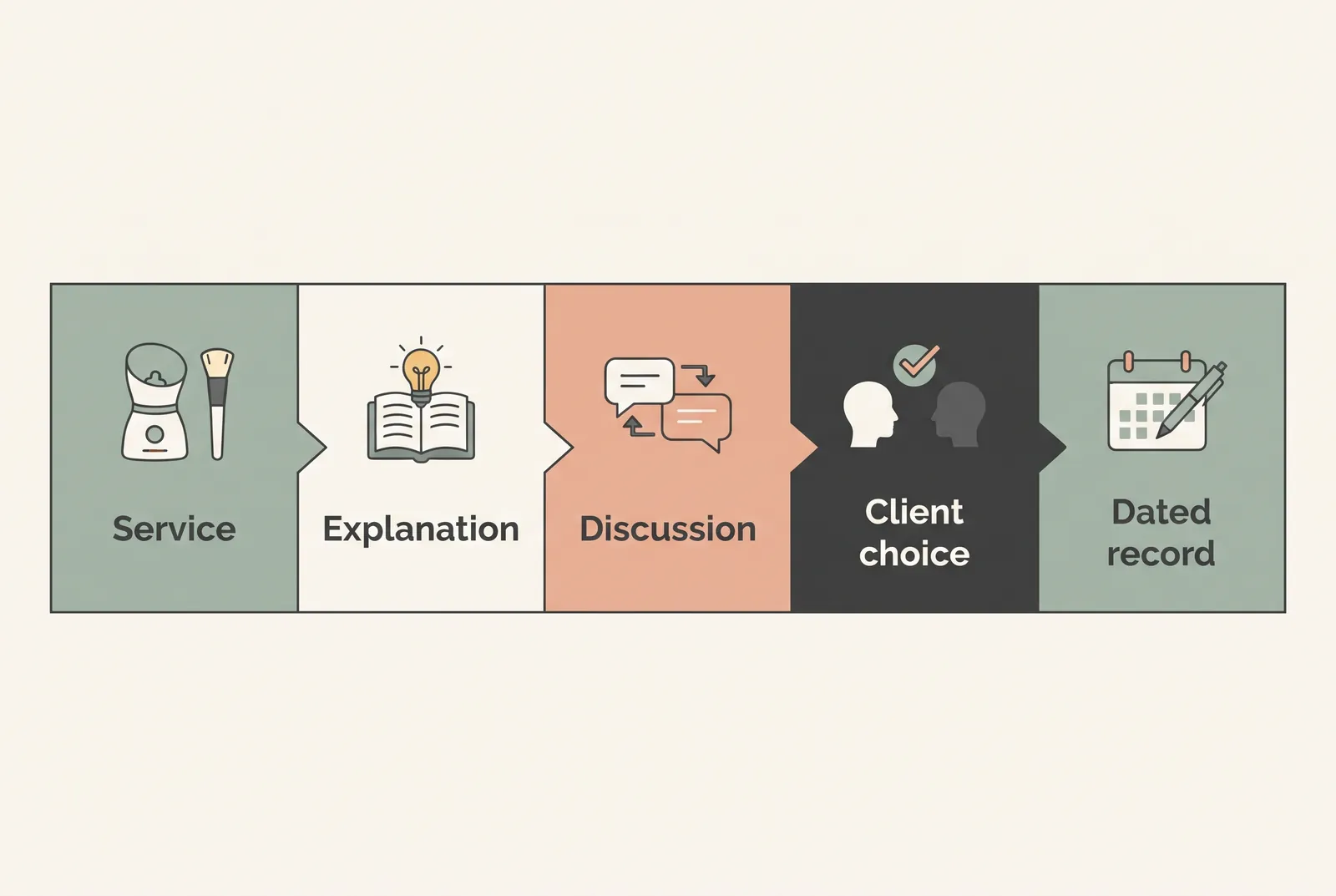
An esthetician consent form is easiest to review when it records five things: the service, the information discussed, client questions, the client's decision, and a dated acknowledgement. Treat this as an organizing checklist, then compare it with your board's current requirements.
Esthetician consent form means a record of the information discussed with a client about a planned service and the client's choice. The form can support the conversation, but it cannot stand in for the explanation or answer questions on its own. Keep the wording direct enough that a client can tell which service the page covers.
| Part | What to make clear | Prompt to review |
|---|---|---|
| Service | Treatment and area | Which visit does this page cover? |
| Explanation | Plain-language description | Are the steps clear without promising a result? |
| Discussion | Relevant risks, questions, and alternatives | What does this service and location require? |
| Client choice | Decision after discussion | Is there room to pause, ask, or decline? |
| Record | Identifiers, acknowledgement, and date as required | Can you match this page to the visit? |
Do not turn the checklist into a medical screening tool. Ask only what is relevant to your service and within your role. If an answer raises a question outside your training or scope, pause and follow your professional procedure.
The esthetician client forms guide explains how intake, consent, visit notes, photo permission, and aftercare have different jobs. Consent belongs to a specific service discussion. It does not replace intake or the record you complete after the visit.
How do state rules change what belongs on a consent form?
There is no single national consent form checklist that fits every esthetician service. State rules can name specific procedures and required information, so use your board's current materials to decide what belongs on your version.
For example, Iowa Code section 157.5 describes written consent before certain services involving certified laser products, intense pulsed light for hair removal, chemical peels, or microdermabrasion. It says the consent must state the nature and purpose and reasonably determinable known risks, acknowledge disclosure and questions, and be signed. That is an Iowa example, not a rule for every state.
Oregon's client record form and OAR 817-015-0065 illustrate a different level of detail for chemical peels and dermaplaning. They call for procedure-specific records and a signature acknowledging information that includes risks, potential complications or side effects, contraindications, alternatives, and aftercare. The rule also lists additional record details for those services.
Those examples are a reason to check your own board, not to copy another state's form. Rules can change, and a service's scope can differ by state. Pennsylvania's State Board of Cosmetology says board staff cannot give legal advice or interpret the act and regulations. For a question about your own practice, use the current board materials and a qualified attorney.
Georgia's Rule 360-35-.08 sets written disclosure and consent requirements for cosmetic laser services. It includes the procedure, material risks, practitioner qualifications, and steps to follow if complications occur. The rule applies to the cosmetic laser practitioners it covers; it is not a general esthetician form checklist.
Before you adapt a template, write down the service, your location, and the specific rule or board guidance you checked. If you cannot confirm that a service is within your scope, resolve that first. A consent form cannot make an out-of-scope service appropriate.
This quick source check can help you avoid copying a form that was written for a different jurisdiction:
- Find the current esthetics or cosmetology rules on your state board's site.
- Search the rules for the service name and terms such as consent, client record, signature, and retention.
- Note whether the rule applies to all services or only named procedures.
- Confirm what the rule says about client information, the service discussion, record format, and how long to keep the record.
- Save the source and date you checked it with your office procedure.
For example, Oregon's rule identifies specific record details for chemical peels and dermaplaning, including the procedure area, sensitivities, complications, and referrals where applicable. A peel record also includes the chemical and process details listed in the rule. That example shows why a short generic form may need a separate service page or record section. It does not mean Oregon's requirements apply to a practitioner elsewhere.
How should consent stay separate from intake, image permission, and aftercare?
Consent is only one part of a client's paperwork. Keep its purpose clear so a client knows what they are agreeing to and you can find the right record later.
- An intake form is a page that collects a client's background and goals before planning. Keep questions relevant and explain why you ask them.
- Consent records the discussion and the client's choice for a named service.
- Image permission is the client's choice about whether a studio may capture or use a photo or video. A treatment signature should not silently stand in for it.
- Visit note records what service took place and any next step discussed.
- Aftercare gives service-specific directions to take home. It is not a replacement for explaining the service before it begins.
For a service with more than one step, confirm that the form names the procedure covered. Do not assume that a signature for one treatment covers a different treatment added later. If the plan changes, stop to discuss the new plan and document it according to your procedure and local requirements.
What does a filled esthetician consent form example look like?
This hypothetical example shows how to organize a record. It is not a legally reviewed consent form and does not give treatment instructions.
Client: Jordan Lee
Service discussed: A scheduled facial service, as confirmed with the client
Area: Face
Discussion recorded: The esthetician explained the planned service in plain language and reviewed the information required by the studio's current procedure. Jordan asked whether the service included an optional add-on. The esthetician clarified that it did not.
Client choice: Jordan chose to proceed with the scheduled service only.
Follow-up: Any service-specific note or aftercare is recorded in its own place.
Acknowledgement: Signature and date fields completed according to the studio's procedure.
The useful detail is the clear boundary: the example identifies one service and records a question and decision. It does not claim the client is medically cleared, promise an outcome, or create universal legal wording. Your form should reflect the actual service and the requirements that apply where you practice.
How can you check a consent template before using it?
Review the page before each new service or form revision. Confirm the service name, the explanation a client will read, any service-specific items required by your board, and the way the client records a decision. Make sure there is enough room to note a question or a change in plan.
Check the order of the page from the client's point of view. Put the treatment name near the top, then the explanation and service-specific information, then the decision and acknowledgement. Avoid a signature line that appears before the information it is meant to acknowledge. Leave enough space for any required details instead of squeezing them into a general notes box.
Then check the record itself. Use a legible date and the practitioner details your rules require. Store completed records with appropriate access limits, and follow local requirements for retention. Do not collect extra personal details simply because a blank field is available.
If you work across services, keep versions easy to distinguish. Retire older copies when you change wording. Check that a booking link or printed packet does not still contain an outdated form. Revisit your process when you add a service or when your board publishes updated guidance.
Scope is another check before consent. Michigan's Occupational Code section 339.1210 lists services permitted for Michigan estheticians, including exfoliation of dead skin cells and nonmedical grade chemical peels. That list describes Michigan law only. Confirm your own state's scope rules before preparing paperwork for a service.
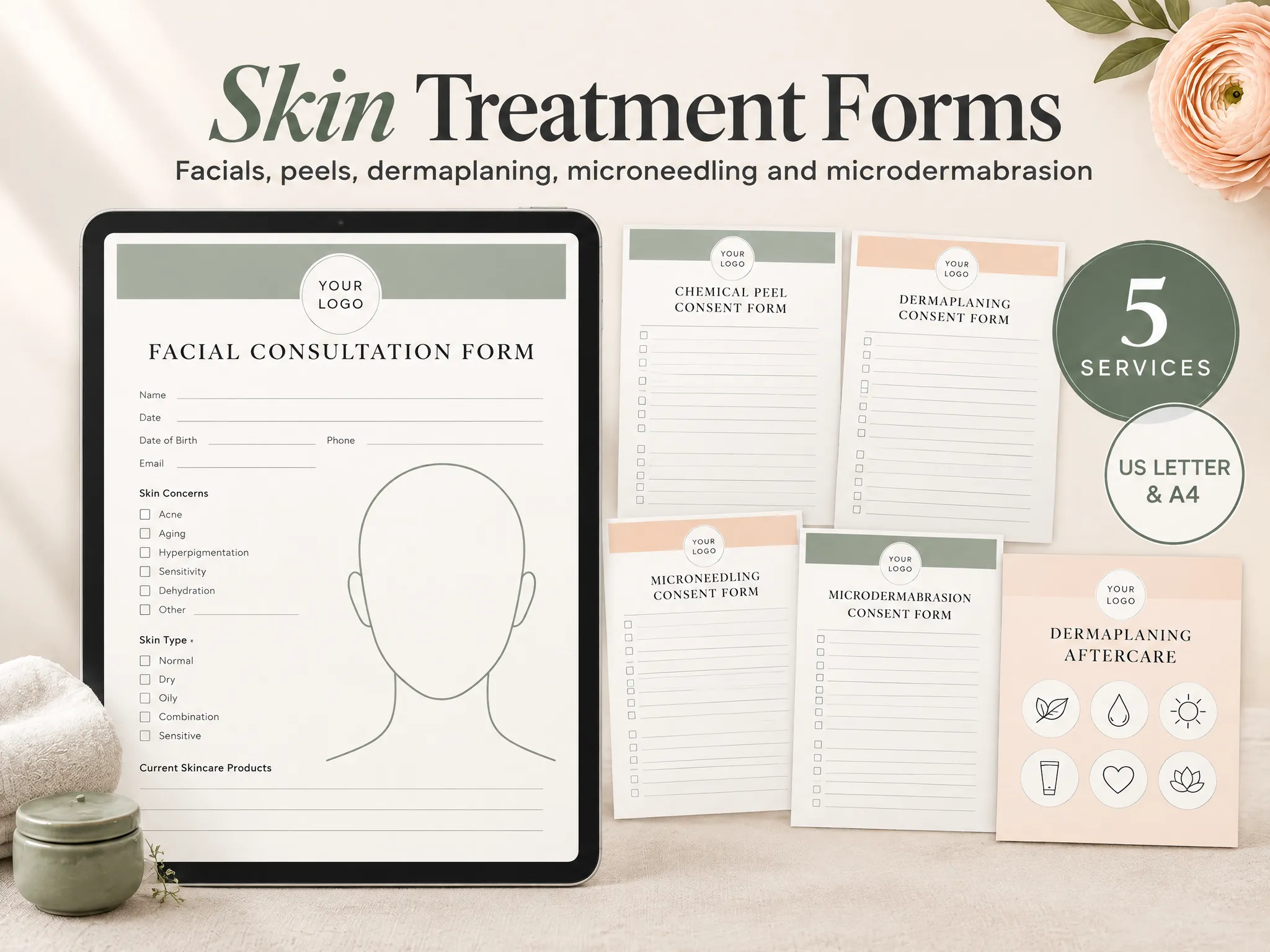
Use the esthetician forms checklist alongside your own board's materials. If you need a starting point for organizing service-specific paperwork, you can review the Esthetician Business Kit forms. The kit lists forms by service, but its templates still need your review against your state and practice.
Why trust this article
This guide is from Esthetician Business Kit by Cosmo Suite. It uses the product's approved contents list and state materials from Iowa, Oregon, Pennsylvania, Georgia, and Michigan for the examples above. The sources were checked on October 22, 2026. Read the site's editorial policy, About page, and Contact page. Templates are general information, not legal advice. Check your board's current rules before using a form.
Where Esthetician Business Kit fits
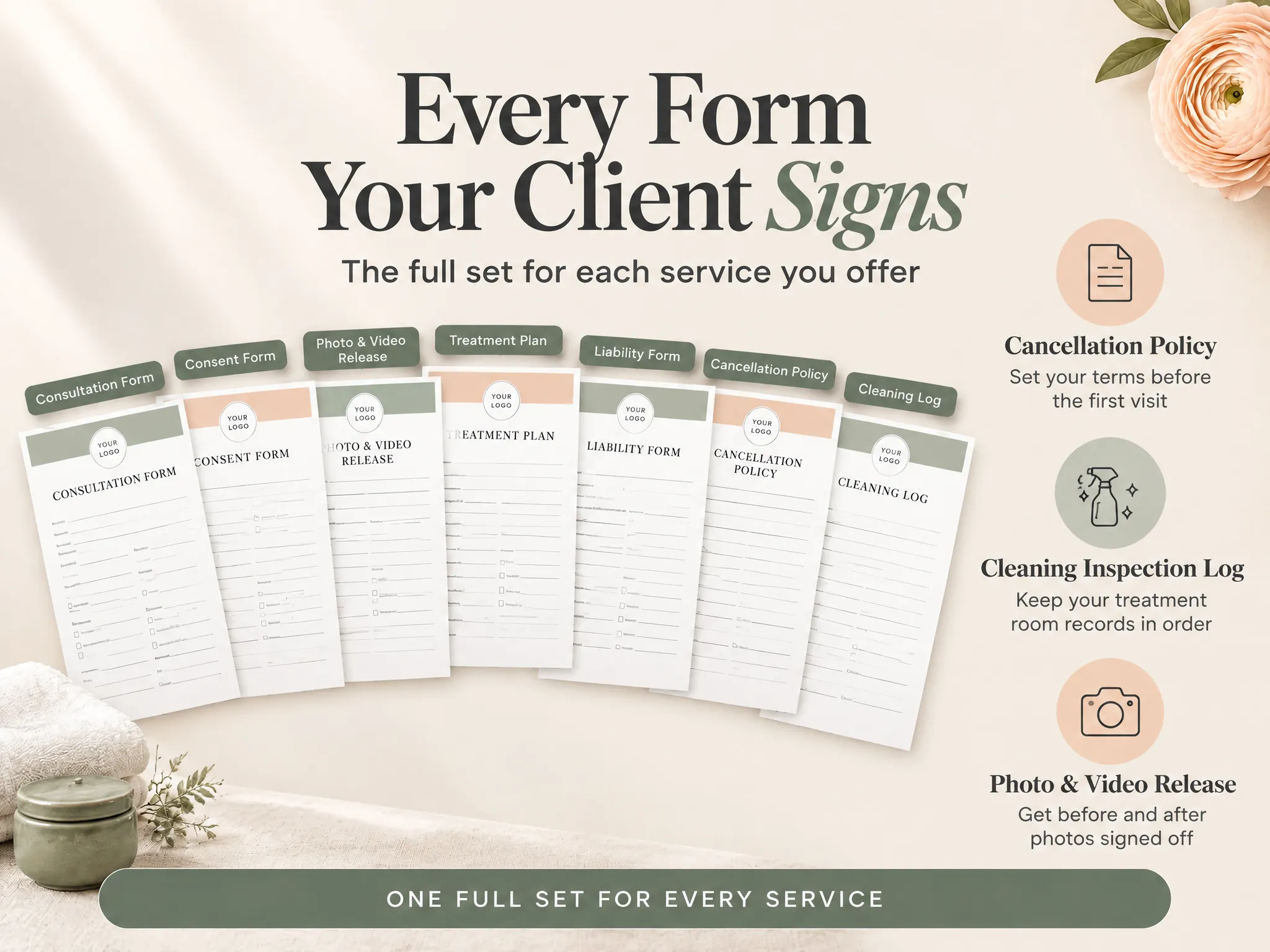
Esthetician Business Kit is a Canva set of forms organized across 14 services. The approved contents list includes consultation, consent, photo and video release, treatment plan, consent and liability, cancellation policy, and cleaning inspection log forms for each service, plus aftercare cards for seven service categories and a skin analysis form.
The files are offered in US Letter and A4 for print or digital use with a free Canva account. A service-by-service form kit for estheticians can give you pages to review and adapt. It does not determine which forms your state requires or whether a service falls within your scope. Check those points before using any template.
Frequently asked questions
What should an esthetician consent form include?
Start with the service name and area, a plain-language description, the risks or questions you discussed, the client's questions and decision, and a signature and date. Add details required for that service in your state. A general checklist is not a substitute for your board's current rules or legal advice.
Is an intake form the same as an esthetician consent form?
No. Intake gathers background and goals that help you prepare. Consent records information about a particular service and the client's decision after a discussion. You can put both on one page if the sections remain clear and the client can review them separately.
Does a signed consent form protect an esthetician from a lawsuit?
No form can promise that. A signature records a step in a client discussion; it does not prove that a service was within scope, replace training, or settle a legal dispute. Ask a qualified attorney about wording and keep following your state board's rules.
Do clients need a new consent form at every appointment?
It depends on the service, the information that has changed, your policies, and state requirements. Review the form when the service changes or new information affects the discussion. Check your board's rules before deciding when a new signature or acknowledgement is needed.
Can an esthetician use one consent form for every service?
A shared page can collect common information, but the service discussion should identify the treatment the client is considering. Some state requirements call for details tied to a particular procedure. Keep a separate service section or page when that makes the record easier to understand.
Are esthetician consent form templates legal advice?
No. A template is a starting point for organizing information. It cannot confirm that wording meets your state's law or your service's requirements. Check the current rules where you practice and consult a qualified attorney when you need legal advice.
Sources
- Iowa Code, Chapter 157, Section 157.5: Consent and reporting requirements
- Oregon Health Licensing Office: Esthetics Client Record and Waiver Form and OAR 817-015-0065
- Pennsylvania State Board of Cosmetology
- Michigan Occupational Code, Section 339.1210: Esthetician permitted services
- Georgia Rule 360-35-.08: Cosmetic laser informed consent